PILOTech strengthens cross-border cooperation in pilotage in the Central Baltic region

PILOTech brings together partners from Estonia, Finland, Latvia, and Sweden to test and evaluate innovative low-emission technologies, improve operational efficiency, and strengthen cross-border cooperation in pilotage. Tallinn University of Technology, TalTech, is lead partner. The project is funded by Interreg Central Baltic.
The project aims to deliver practical and scalable solutions to reduce CO₂ emissions from pilot boat operations in the Central Baltic region.
The project runs until the end of April 2029 and has a total budget of EUR 2.7 million.
Ahmed Elhadi, Novia’s Project Manager for the project, answers the question of how Finland, Sweden, Estonia, and Latvia could collaborate more closely on pilotage services than they do today.
“On a broad level, the countries can exchange experiences and best practices in the technical and operational aspects of pilotage through stakeholder dialogue workshops and platforms for cross-border collaboration.”
The project's main objectives are to develop CO₂ reduction strategies and assess the feasibility of their implementation in pilotage operations. The researchers involved will test methods and technologies aimed at reducing CO₂ emissions from pilot boats.
An important aspect of the project is also the transfer of knowledge between the partners.
Novia Leads a Cross-Border Feasibility Study on Hybrid and Alternative-Fuel Pilot Boats
Novia’s role in the project is to lead a cross-border feasibility study on diesel–electric hybridisation and alternative-fuel retrofits for pilot boats. Novia will also prepare a report on the CO₂ impacts of remote pilotage and support the project coordinator by organising workshops and developing a training package on remote pilotage practices.
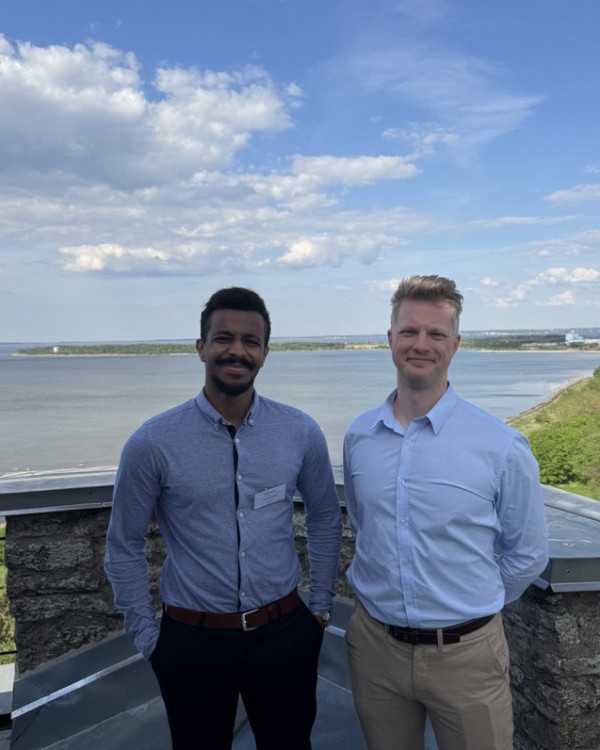
In the photo: Novia researchers Ahmed Elhadi and Touko Herranen.
Additionally, Novia will test simulation-based strategies for reducing CO₂ emissions in pilotage operations and explore simulation-based optimisation strategies for pilot boat fleet resourcing and scheduling.
Other partners in the project include Finnpilot Pilotage Ltd, The Estonian State Fleet, LVR Fleet and Swedish Maritime Administration.