World Creativity and Innovation Day 21.4: Entrepreneurship around Living Cultural Heritage – the LoveKaustinen example

In Kaustinen, cultural heritage increasingly serves as a foundation for new forms of entrepreneurship. The municipality is widely known for the Kaustinen Folk Music Festival, one of the largest folk music festivals in the Nordic countries, which each year gathers up to 5 000 musicians and roughly 50 000 visitors. This strong festival tradition forms a key backdrop for the region’s vibrant folk-music culture and related initiatives.
One example is LoveKaustinen, a relatively new business that develops cultural experiences and services based on the region’s strong folk-music tradition and local cultural life. Rather than treating heritage as something static, LoveKaustinen builds on the idea of living heritage, the traditions that are actively practiced. In this context, the well-known Kaustinen fiddle tradition becomes a platform for creating services, experiences and collaborations that generate both cultural and economic value.
“The company operates by bringing together local musicians, cultural practitioners and service providers into customised offerings. These can take the form of intimate performances, participatory cultural programmes or events that combine music, storytelling and hospitality” says Susanna Salokannel, cultural producer and one of the founders of LoveKaustinen.
Through this model, the cultural heritage is translated into formats that are accessible and relevant to all kinds of audiences, including visitors, organisations and corporate clients.
Cultural Authenticity and Sensitivity
At the same time, the approach highlights an important balance. Cultural heritage carries meaning, identity and community ownership, which means that commercialisation must be handled with care. The value of the experience depends on its authenticity that is rooted in the people and practices that sustain the tradition.
“Developing a sustainable business around cultural heritage requires both sensitivity towards the traditions themselves and openness to make them work in new contexts,” says Susanna.
Respecting tradition while enabling innovation is a central perspective to making heritage-based entrepreneurship viable in the long term. It requires close collaboration with local communities, an understanding of cultural contexts and the ability to translate intangible values into concrete services.
Susanna also emphasises the importance of sensitivity towards the practitioners who carry the tradition. If new service concepts are developed without their acceptance, there is a risk that the results feel inauthentic or even counterproductive. “It requires cultural sensitivity towards those who practice the tradition. Otherwise the service packages built around it may not be embraced by the community itself,” she notes.
This highlights that successful heritage-based entrepreneurship depends not only on market relevance, but also on maintaining trust and dialogue with the cultural community.
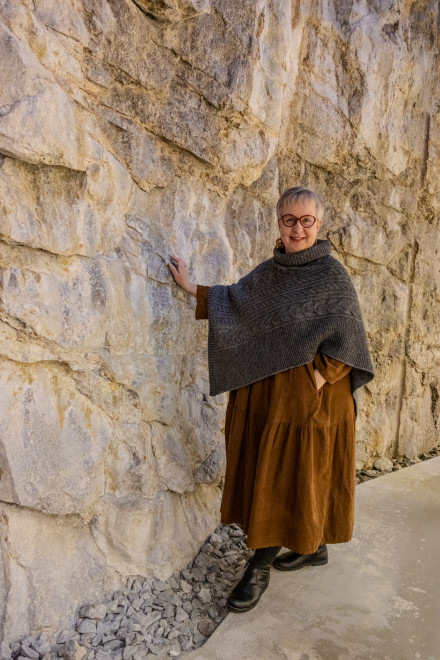
Susanna Salokannel, cultural producer and co-founder of LoveKaustinen, pictured inside the Folk Arts Center in Kaustinen, where parts of the building are integrated into the natural rock landscape. Photo: Daniel Ainasoja
From Local Initiative to Regional Impact
LoveKaustinen illustrates how small, locally anchored initiatives can contribute to broader regional development. By creating new opportunities for artists and cultural professionals, the model supports livelihoods while strengthening the visibility of Kaustinen as a cultural destination beyond its well-known festival period. In this way, cultural heritage becomes a driver for year-round activity rather than a seasonal highlight.
More broadly, the case points to a growing interest in connecting cultural heritage with entrepreneurship, particularly within the creative industries and tourism sectors. As regions look for sustainable ways to build identity, attract visitors and support local economies, living heritage offers a unique resource that combines cultural depth with interactive experiences.
This perspective is also central to the Interreg Aurora project ICH EDU North, where Novia UAS is a partner organisation among seven other organisations in Finland and Sweden. The three year project started in January 2026 and explores how intangible cultural heritage can be integrated into education and lifelong learning while supporting new forms of entrepreneurship within the cultural sector. In this context, initiatives like LoveKaustinen serve as concrete example of how living heritage can be translated into sustainable cultural services and entrepreneurial opportunities.
For more information, please contact
- Novia UAS, Project Specialist, Novia RDI, Daniel Ainasoja, daniel.ainasoja@novia.fi